How Long Does It Take to Form a Habit?
Understand the 21-day and 66-day habit claims without turning them into deadlines. Learn what studies measure and what to review in your own plan.

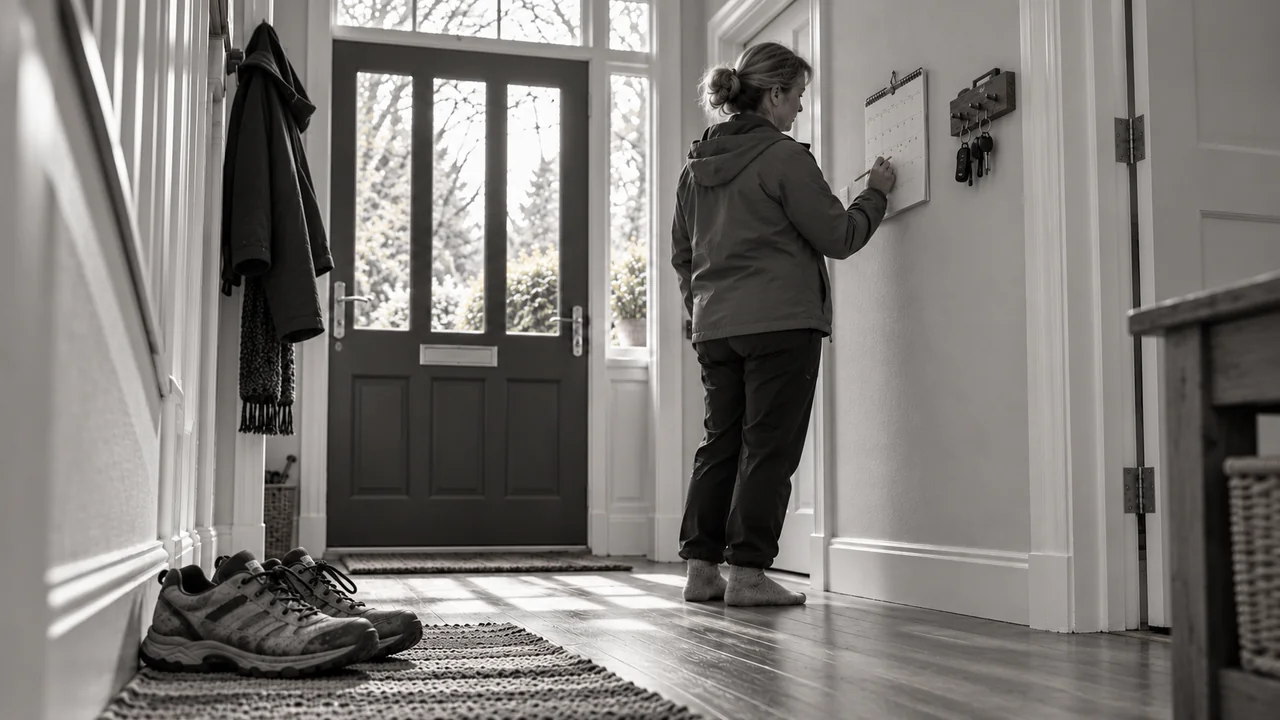
A habit does not arrive on schedule because you reached day 21, 66, or 100. Those dates can give a challenge an end, but they cannot tell you when a familiar cue will start an action with less conscious thought.
Habit formation time varies with the person, action, setting, and way researchers measure it. The useful question is not “Why is this still taking effort on day 30?” It is “Does this action have a workable place, and is it becoming easier to start there?”
You can set a date to review a plan without setting a date by which you must be automatic. That leaves room to keep practicing, change a poor fit, or use a checklist for as long as it helps.
What counts as forming a habit?
In this research, a habit involves a learned link between a cue and an action. A cue is a situation or event associated with the action. Automaticity means less need for conscious thought or deliberate recall.
That is different from doing something often. You can deliberately follow a packing list every workday. The sequence is regular even if you still choose and check each item.
It is also different from finding the whole activity easy. Opening a course book may become familiar while the lesson still requires work. The routine and habit distinction helps separate a start from the rest of a sequence.
Researchers may ask people how automatic an action feels, model changes in those ratings, or study recorded patterns of behavior. Those methods answer related but different questions. None makes a completion streak a direct measure of an automatic start.
Where the 66-day figure comes from
The familiar number is associated with Lally and colleagues' study, published in a 2010 journal issue after first appearing online in 2009. Its original abstract describes 96 volunteers who chose an eating, drinking, or activity action to repeat daily in the same context.
They reported the action and its automaticity over 84 days. Of the 96 volunteers, 82 supplied enough data for analysis. The researchers could fit an automaticity curve for 62 people; 39 met the paper's good-fit conditions.
Those smaller groups matter. A number from selected well-fitting curves is not the time taken by every person who entered the study.
The 2024 review by Singh and colleagues reports the often-quoted 66 days as a median. A median is the middle value in an ordered group of estimates. It is not a day on which everyone suddenly becomes automatic.
The original study estimated when people would reach 95% of their fitted automaticity plateau: the point their model approached as further gains became smaller. That does not mean the action happened automatically on 95% of days. Nor does it mean everyone's plateau represented the same habit strength.
The reported estimates ranged from 18 to 254 days. Because observation lasted 84 days, some values were forecasts beyond the measured period. UCL's explanation makes this explicit: the longest case was predicted, not followed for 254 days.
The useful lesson is variation. Replacing “habits take 21 days” with “habits take 66 days” keeps the same mistake: turning a study summary into a personal deadline.
Does newer research give a better countdown?
The 2024 review brought together 20 studies involving 2,601 participants. It covered health-related actions and several ways of studying habits. It was not one new trial in which everyone followed the same plan.
Only four included studies reported how long habit formation took. The authors did not combine those durations into one timing estimate because the studies were too few and too different. Their statistical combination of results concerned changes in habit scores, not one average time to a habit.
The review also rated 11 studies at high risk of bias. That is a reason to keep confidence in proportion to the evidence, not a reason to declare all the findings useless.
Together, the studies show why a longer countdown is not the answer. The action, population, threshold, and model still matter. Research on a chosen health action cannot give a finish date for an entire morning routine, a study method, or an app user's progress.
Read a timing claim with four questions
You do not need to read every statistical detail to spot the main limits. Start here when a headline gives you a habit number.
| Question | What to look for |
|---|---|
| Who contributed to the number? | All participants, people with enough reports, or a smaller modelling group? |
| What action and measure were used? | One response or a full sequence? Self-report, recorded completion, or a fitted curve? |
| Was the endpoint observed? | Compare the follow-up length with the estimate. Longer estimates may be forecasts. |
| What kind of summary is it? | A mean, median, range, or model estimate? None is an individual promise. |
Scroll sideways to see all columns.
A mean adds the values and divides by their number. A range gives the lowest and highest values in the stated group. Neither tells you that your result must sit at the middle or even inside the reported range.
Watch the action size too. Putting a key in a tray is one response. “Exercise every morning” can include choosing, changing clothes, traveling, training, and recovery. A label that combines all those parts hides what is being timed.
Use a review point instead of a finish date
For your own plan, choose a review point when you will have some real practice opportunities to consider. The date is for making a decision, not for testing whether you have met a habit deadline.
At the review, keep three questions separate:
- Completion: Did the chosen action happen?
- Fit: Did the cue, place, materials, and time work?
- Starting: What brought the action to mind, and how much deliberate recall did it need?
A yes to the first question is valuable. It does not settle the other two. You may complete an action reliably because a paper note is useful, not because you no longer need the note.
- Choose one responseName the action and its clear finish.
- Repeat at a usable cueCheck that the place and materials are available.
- Keep two kinds of notesRecord completion separately from how starting felt.
- Review and decideKeep, change, reduce, or stop the plan.
A review date helps you choose what to do next. It does not certify that a habit exists.
Worked example: a book after lunch
Suppose your plan is to read one paragraph after putting your lunch plate in the sink. The book is meant to stay on a nearby dry side table. You choose to review after seven days when you plan to have lunch at home.
Seven opportunities are just an example review interval. They are not enough evidence to announce that a habit should have formed.
At the review, imagine your notes show three different situations:
- The cue did not occur because you ate away from home.
- The cue occurred, but the book had been put in a cupboard.
- You read the paragraph after looking at your written card.
Those entries should not all become “habit failed.” The first concerns the schedule. The second concerns access to materials. The third records completed reading with deliberate support.
A useful next choice might be to review your expected lunch location and choose a better place for the book. Keep the written card if it helps. There is no need to remove it just because a challenge has ended.
If the reading no longer matters to you, you can stop the plan. Time already spent is not a reason to preserve an action without a purpose.
For help choosing the cue itself, use the one-link habit stacking guide.
What a missed day means
Lally and colleagues' original abstract reports that missing one opportunity did not materially affect the process in their analysis. That is narrower than saying all gaps are harmless. It does not cover every action, repeated absences, or interruptions of any length.
A blank day also does not show that all previous practice vanished. First find out what happened. Was the cue absent? Were materials missing? Did you need rest? Was the action done but not recorded?
Use that information for the next attempt. Return at the next suitable opportunity, change the plan if its setting has changed, and deal separately with any real deadline or care requirement. General habit findings do not override task instructions.
What to do when it still takes effort
Check the part that is hard before adding more repetitions.
If remembering is difficult, make the cue or written action clearer. If setup takes too long, prepare the materials or choose a better place. If starting is easy but the work is demanding, the task may still need skill, attention, rest, or help.
You do not have to turn every important action into a habit. A deliberate routine with clear instructions can remain useful. Keep checks where accuracy or safety matters, even when the movements feel familiar.
If the whole plan repeatedly exceeds your available time, reduce the demand. A longer streak cannot create extra hours or make an unsuitable workload fit.
Where Skye fits
Skye guides a routine you choose with separate task timers. Enter the steps, order, and durations manually, then pause, skip, or change the time as needed. See routine and timer help for the controls.
Skye counts consecutive calendar dates with completed or partial routine sessions, not consecutive scheduled days. The streak stays active when the latest qualifying session was today or yesterday; otherwise it is zero. That is an app counting rule, not a finding that earlier learning has been erased. A long streak is not proof of automaticity either.
Use the timer for guidance during the sequence and keep any notes about starting separately. Paper can do the review job without an app. The research discussed here does not establish a habit-formation deadline or measured habit benefit for Skye.
Frequently asked questions
Should I review my habit plan after 21 or 66 days?
You can choose either as a review date, but neither is a deadline for becoming automatic. Look at whether the cue occurs, materials are ready, and starting needs less deliberate recall. Use the habit stacking guide if the cue itself needs a clearer place.
Does my Skye streak show that a habit has formed?
No. Skye counts completed or partial sessions on consecutive calendar dates, with the latest qualifying session today or yesterday. The count does not measure automaticity and does not skip unscheduled days. Use Skye's timer controls to guide the sequence, and review how starting feels separately.
What should I do after missing a planned opportunity?
Check whether the cue happened, what blocked the action, and whether the plan still fits. Return at the next suitable opportunity without treating the gap as proof that all learning vanished. For a longer break, use the routine restart guide to separate returning from catch-up work.
Give the plan time, and keep checking its fit
Choose an action worth repeating, give it a usable cue, and set a review point. Keep the support you need instead of waiting for all effort to disappear on a named day.
If ordered timers suit your routine, use Skye to guide the steps, not to set a habit deadline.
Skye facts checked against app source October 20, 2026. The app was not tested for this update; external source checks were not repeated.
A little space for ideas that fit into real life.
More from the blog