Evening Routine Checklist: Prepare a Little, Then Stop
Use an evening routine checklist to prepare tomorrow without filling tonight. Copy a short tomorrow card, a 20-minute example, and a clear stop rule.

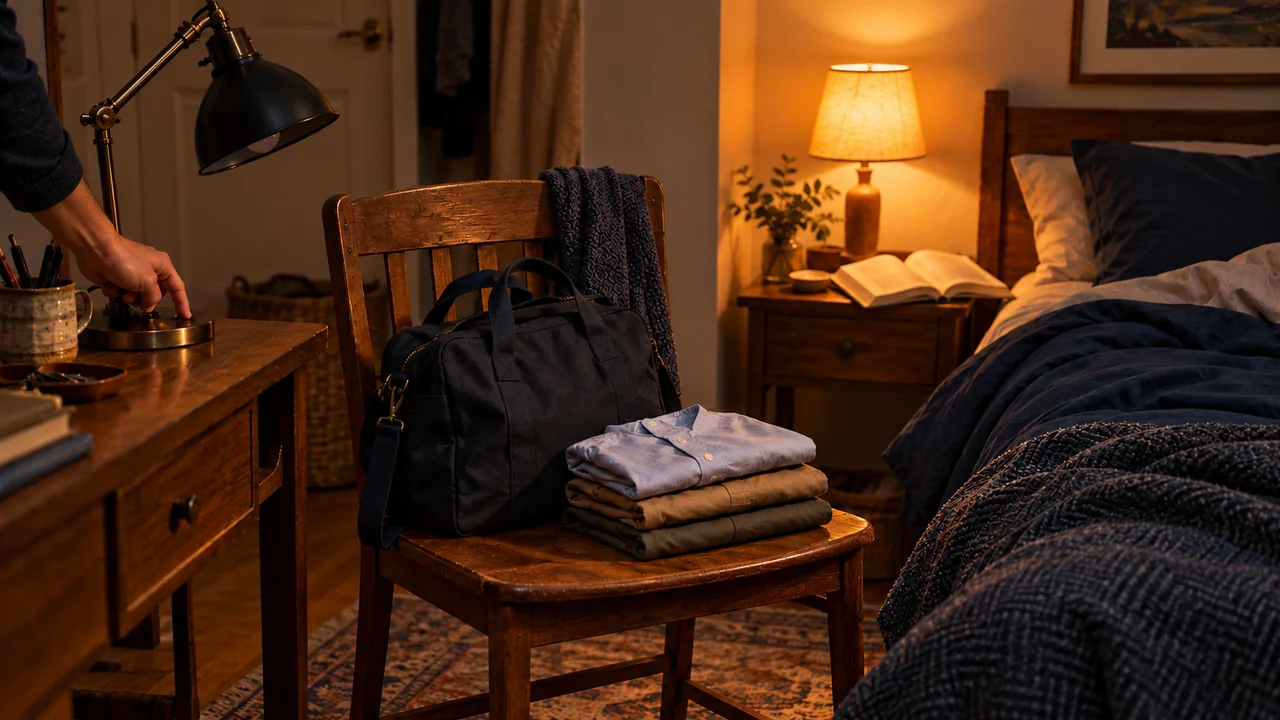
You find tomorrow's appointment letter. Beside it is a pile of old papers. Ten minutes later, the letter is still on the table and you have started sorting a drawer.
An evening routine checklist needs a stop rule as much as it needs tasks. Its job is to prepare a few things tomorrow needs, not to finish everything left from today. Necessary care and time to rest do not have to wait until the home feels complete.
Try two separate parts: a short preparation sequence, then personal care and room to wind down. The checklist below includes a tomorrow card, an example preparation window, and a smaller option for late evenings. None requires an app.
Decide what would genuinely help tomorrow
Choose a useful result, not a broad goal such as “get organized.” You might need the correct bag packed, suitable clothes available, or a document located. Once that result is clear, it becomes easier to leave unrelated work alone.
Use three places for the things on your mind:
- Tonight: What must happen before you stop.
- Tomorrow card: The first commitment, needed items, and one useful note.
- Later list: Non-urgent work that needs another decision.
Finding a clean shirt belongs to tomorrow preparation. Sorting every shirt does not. Clearing a place to make breakfast may belong; cleaning the whole kitchen may be a separate job.
If housework is the main need, use a small cleaning checklist with its own boundary. Do not hide a full cleaning session inside the word “reset.”
Give preparation an end before you begin
Choose a start event that fits your evening, such as clearing your meal place or returning from an evening commitment. Then write the end point.
For example: “I stop when my required items are ready and the tomorrow card is written. I will not start sorting old papers.” A time boundary can support that rule, but the required result should remain clear.
Keep personal care and quiet time outside the chore total. The National Heart, Lung, and Blood Institute recommends giving sleep enough time and using time before bed for quiet activity. That is general sleep guidance, not proof that this checklist improves sleep.
If preparation keeps taking longer, reduce its scope. A missing stop point is not a reason to fill the rest of the evening with better-timed chores.
- CheckFirst commitment and required items
- PrepareOnly the items tomorrow needs
- CloseWrite what can wait
- StopLeave room for care and rest
Quiet time is outside the preparation total. It does not need another task list.
Copy the tomorrow card
The card should answer a few practical questions at a glance. It is not a full schedule or a second to-do list.
TOMORROW
First commitment:
Ready or leave by:
Required items:
Where those items will be:
Chilled item to collect later:
Shared task or handoff to confirm:
One useful note:

NOT TONIGHT
Work that can wait:
Check the first fixed commitment and the preparation it needs. If travel is involved, write the leave time you have worked out. The morning checklist shows how to keep arrival, travel, and getting-ready time separate.
If tomorrow has no appointment, name a real responsibility or a chosen starting event. “After breakfast, check the repair booking” may be enough. You do not need to invent a rigid start time just to fill the card.
For a shared responsibility, write an agreement rather than an assumption. “Delivery: Alex agreed to be home” is clearer than a tick beside “delivery sorted.” If the handoff is still open, leave that state visible.
The evening routine checklist: two parts
Keep only the actions that apply. Food preparation, care duties, and household arrangements differ; a useful list should reflect yours.
Part one: prepare what tomorrow needs
- Check the first commitment and ready or leave time.
- Write the short tomorrow card.
- Put required documents and bag items in a known place.
- Check that suitable clothes are available.
- Prepare food only as appropriate and store it safely.
- Leave a collection cue for chilled items.
- Confirm any necessary household handoff.
- Make one needed space usable, if it belongs in tonight's plan.
- Write non-urgent work on the later list.
- End preparation at the chosen boundary.
Keep chilled food in safe storage, not beside the bag for convenience. The FDA's food-storage advice says to refrigerate perishables promptly and check storage directions. The card can hold the reminder while the food stays where it belongs.
Part two: care and room to wind down
- Complete your necessary personal care without rushing.
- Follow your usual dental care and any individual care instructions.
- Make your resting space suitable for your needs as far as practical.
- Put the card or screen aside when it is no longer needed.
- Choose a quiet activity or leave the time unplanned.
- Leave optional chores alone.
Care for another person follows their needs and care process, not the preparation countdown. A stop rule also does not mean ignoring an urgent safety issue. It means that ordinary unfinished work does not get to extend the list by default.

A worked example: 20 minutes of preparation
Suppose tomorrow's appointment starts at 9:30. You allow 30 minutes for travel and 15 minutes for arrival, so you need to leave at 8:45. Tonight, you want the appointment letter in your bag, suitable clothes available, and one kitchen space ready to use.
This is an editable example. The 20-minute window includes 15 minutes of selected preparation and five unassigned minutes. Personal care and quiet time need separate room.
| Time | Action | End point |
|---|---|---|
| 20:30–20:33 | Check tomorrow | The commitment and leave time are on the card. |
| 20:33–20:39 | Prepare required items | The letter is in the bag and suitable clothes are chosen. |
| 20:39–20:43 | Make one space usable | The chosen food-preparation area is ready. |
| 20:43–20:45 | Close the card | The handoff is checked and later work is written down. |
| 20:45–20:50 | Leave room | Five minutes remain unassigned. |
Scroll sideways to see all columns.
The task total is 3 + 6 + 4 + 2 = 15 minutes. Add the five-minute buffer and preparation ends at 20:50.
Your filled card could read:
Tomorrow: Appointment at 9:30; leave by 8:45. Letter and access items in the usual bag. Clothes on the chair. No chilled item needed. Delivery handoff confirmed. No extra errand before leaving. Not tonight: Sort old papers.
If finding the letter takes three extra minutes, three of the five spare minutes are used. If the search continues, leave out the optional kitchen task and make a new decision about the document. Check the appointment instructions or seek the help you need; do not assume a substitute will be accepted.
The stop time should not move silently each time something takes longer. Keep essential needs, reduce optional work, and name any remaining problem.
Use a four-line version when the evening is short
A late shift, a care duty, or an unexpected delay may leave no room for the full sequence. Reduce the work before trying to fit it into smaller timer numbers.
Use four lines:
- First commitment: What needs to happen next?
- Required items: What would block that commitment if missing?
- Necessary care: What still needs time and attention?
- Stop: What can wait until another suitable time?
This version does not require a home reset, a detailed plan, or a quiet activity chosen from a list. Rest can remain unplanned. For broader changes in available effort, see the low-energy routine guide.
If you share a home, agree on where tomorrow items can go without blocking access. If another person shares care duties, confirm the handoff. A checklist can show an agreement; it cannot create one on the other person's behalf.
Do not turn sleep into the checklist's score
The useful result is that tomorrow's needs are clearer and the preparation sequence has ended. How quickly you fall asleep is a different question.
You may finish the card and still feel alert, worried, or tired. That does not tell you whether you need a longer routine. Avoid adding more rules each time sleep is difficult.
If sleep problems continue or affect daily life, seek health advice. The NHS recommends seeing a GP when sleep changes have not helped, problems last for months, or insomnia makes daily life hard to manage. A preparation checklist is not a diagnosis or treatment for a sleep condition.
You can keep the preparation sequence screen-free. Put the card down when the required items are ready. There is no need to keep reopening a tool to prove that you are winding down correctly.
Use timing only for the preparation that needs it
Paper may be the best fit if the task order is enough. A basic timer can mark the point to review optional preparation. Leave care and quiet time untimed if that suits you.
Skye can guide the short ordered sequence with a timer for each task. Enter your own tasks and durations, then pause, skip, or change the time when needed. The routine and timer help explains setup. You still choose the steps and decide when the plan needs to change.
The timer does not establish a sleep benefit. If using a screen adds work you do not want, keep the card instead.
Frequently asked questions
What should I prepare tonight if I only have a few minutes?
Check the first commitment, locate its required items, and note anything still missing. Leave optional sorting and cleaning on the later list. The morning checklist can help you decide which items would otherwise delay leaving.
Can I time preparation in Skye without timing my whole bedtime routine?
Yes. Enter only the preparation steps you want timed and leave care or quiet time outside that sequence. See Skye timer help for the controls; a completed sequence is not a sleep measure.
What if the preparation routine keeps taking over the evening?
Check which step expands and give it a smaller result, such as finding one letter rather than sorting all papers. Keep necessary care and room for sleep, and stop adding chores once tomorrow's required items are ready. Seek health advice for ongoing sleep problems rather than extending the checklist.
Prepare a little, then let the evening end
Write the first commitment, prepare the required items, and leave the rest on the later list. Keep personal care outside the chore budget. The evening does not need to end with everything done; it needs a clear point where preparation can stop.
External sources checked October 19, 2026. Skye facts checked against app source October 20, 2026. The app was not tested for this update. The card and time allowances are planning examples. General sleep guidance does not establish results for this checklist or Skye.
A little space for ideas that fit into real life.
More from the blog