Morning Routine Checklist: Start With the Day You Have
Build a morning routine checklist with a clear task order, realistic times, and a shorter backup. Copy a worked example and protect your leave time.

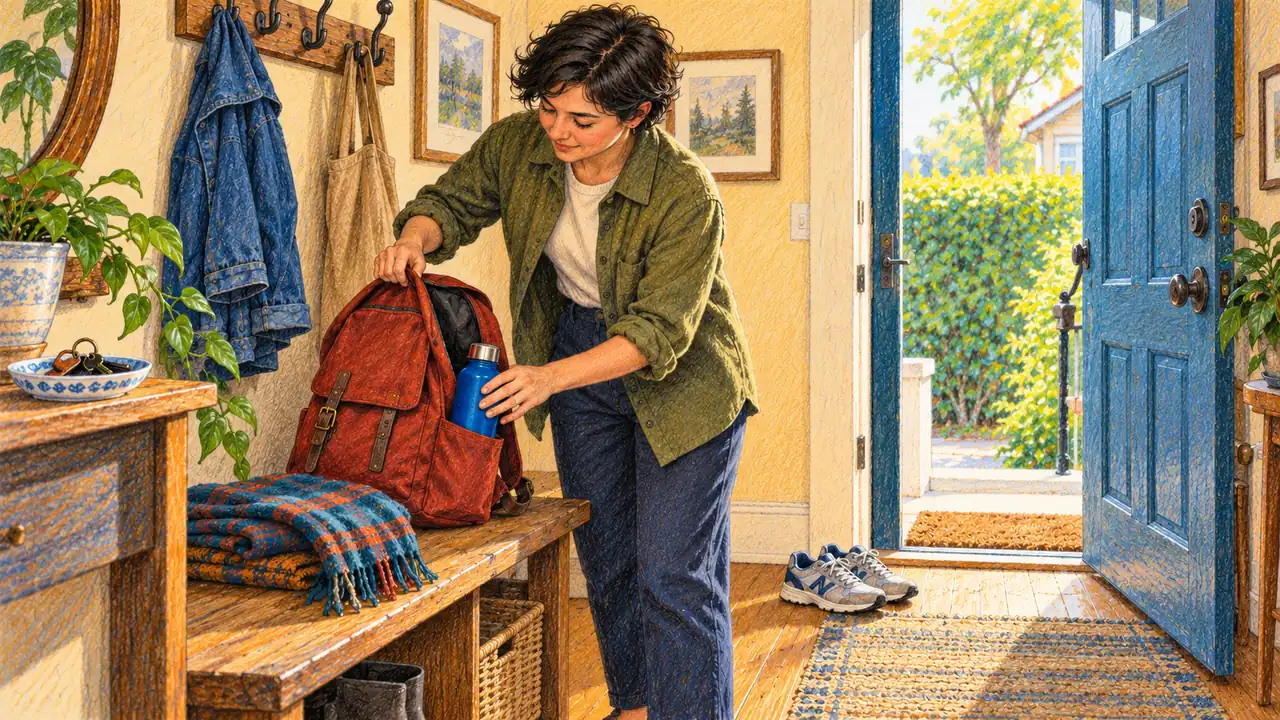
You are almost ready. Then you remember the lunch in the fridge, the access card in yesterday's bag, and the shoes that still need finding. None is a large task. Together, they can take the time you thought you had left.
A useful morning routine checklist makes that last stretch visible. It starts with when you need to be ready, puts the required actions in order, and leaves some time unassigned. It does not need a cold shower, a journal, or someone else's wake-up hour.
Below is a checklist you can copy, a complete 8:00 departure example, and a shorter version for a late start. Change the tasks and times to match your care needs and your actual morning. Paper and a clock are enough.
Start with your leave time, not your alarm
First, write what “ready” means. Leaving your front door is not the same as arriving at a desk or reaching a classroom. Work back from the commitment before you decide when to start getting ready.
For example:
- Arrive by 8:50.
- Allow 15 minutes for the walk from arrival point to room and check-in.
- Allow 35 minutes for the journey.
- Leave home at 8:00.
Now work back through the at-home tasks. If those take 40 minutes and you keep 10 extra minutes for delays, start at 7:10. That gives you a 50-minute getting-ready window.
The travel allowance and the at-home buffer do different jobs. A buffer is extra time with no task assigned. Do not count the same ten minutes as spare time at home and spare time on the journey.
For work at home, choose another clear end point: “personal preparation complete before my first appointment,” for example. A missing commute does not mean you must fill the morning with more tasks.
- Arrive8:50 commitment
- Leave8:00 after travel allowances
- Keep room10 minutes unassigned
- Begin7:10 for 40 minutes of tasks
Example times only. Keep travel, preparation, and spare time separate.
Choose what this morning actually needs
A getting-ready list has one job: prepare you for the next part of your day. Separate its tasks before adding optional habits.
- Required: Necessary care, suitable clothes, food arrangements that meet your needs, and items required for today's commitment.
- Helpful: Tasks you can replace with a suitable option, such as preparing lunch when another food choice is available.
- Optional: Reading, extra tidying, or another activity you can move without causing a problem.
These labels depend on you. Do not make a care task optional because a generic checklist leaves it out. If you care for another person, give that responsibility its own real allowance rather than hiding it in spare time.
Be careful with the easiest apparent fix: an earlier alarm. CDC sleep guidance says that both enough sleep and good sleep quality matter. Remove optional work or change preparation before treating sleep as time you can take.
You can place helpful tasks in an evening preparation routine, but only if that evening has room. Moving too much work to the night before does not make it disappear.
Copy this morning routine checklist
Use this order as a starting point. Move tasks around shared bathroom access, your care instructions, and the way your household works.
Check the day
- Confirm the first commitment and leave or ready time.
- Check anything that changes today's preparation, such as weather, travel, or required equipment.
- Choose the full list or your shorter version before starting.
Meet your personal needs
- Use the bathroom and complete your usual washing steps.
- Get dressed in suitable clothes and required layers.
- Prepare, eat, or collect the food you have chosen.
- Complete dental care and other necessary personal care in the order that fits your needs.
The NHS advises brushing twice a day for about two minutes, including last thing before bed and one other occasion. That does not make two minutes enough for an entire personal-care block. Include setup and your other care steps, and follow individual dental advice.
Check what leaves with you
- Put today's required items in your bag.
- Collect chilled food at the appropriate point and follow its storage needs.
- Check keys, access items, shoes, and outer layers.
- Complete the final household and door checks you need.
Keep food safety ahead of convenience. The FDA advises prompt refrigeration of perishables and checking storage directions. A note by your bag can say “collect lunch”; the lunch does not need to sit by the door.

A worked example: leave home at 8:00
This example begins after getting out of bed. It assumes no extra care duty within the sequence. The allowances are editable planning examples, not ideal durations or tested results.
| Time | Action | Finished when |
|---|---|---|
| 7:10–7:12 | Check the day | The commitment and leave time are clear. |
| 7:12–7:19 | Bathroom and washing | Your chosen washing steps are complete. |
| 7:19–7:25 | Get dressed | Suitable clothes and layers are ready. |
| 7:25–7:37 | Breakfast | Your food needs for this step are met. |
| 7:37–7:42 | Remaining personal care | Your necessary care steps are complete. |
| 7:42–7:47 | Check bag and collect food | Required items are checked and food is handled safely. |
| 7:47–7:50 | Shoes and final check | You are ready to leave. |
| 7:50–8:00 | Unassigned buffer | No extra task is required. |
Scroll sideways to see all columns.
The task allowances are 2 + 7 + 6 + 12 + 5 + 5 + 3 = 40 minutes. With the ten-minute buffer, the window is 50 minutes. Waking and travel are outside that total.
Suppose the shared bathroom becomes available four minutes late. If the other tasks keep their allowances, four buffer minutes are used and six remain. You do not need to rewrite every step during the delay.
Now suppose the bag is missing an essential document. An open-ended search is a different problem. Check for a suitable alternative or change the arrival arrangement. Do not keep following the table as if its original finish time were certain.
Give hidden work an honest time allowance
“Shower” can include finding a towel, washing, drying, dressing, and leaving the bathroom usable. “Pack bag” can mean a quick check or a search through three rooms. Short labels can hide long tasks.
For a few ordinary mornings, note the start and finish of the task that keeps surprising you. Record an interruption separately. Waiting for a bathroom is not the same as needing more time to wash.
Then choose one change:
- Increase the allowance if the work normally takes longer.
- Put the missing item in a known place.
- Split preparation from the final check.
- Reduce optional work.
- Agree on shared space access.
The task-time estimate guide covers this in more detail. You do not need a detailed log for every action. Start with the one mismatch that affects the rest of the morning.
Make a shorter version by removing work
A backup routine should ask less of you, not ask you to do the same work faster. Keep necessary care intact. Reduce preparation where a suitable choice is already available.
For example, a shorter version could use:
- 1 minute: Check the day.
- 7 minutes: Bathroom and washing.
- 4 minutes: Put on clothes already chosen.
- 7 minutes: Use a suitable food choice that needs less preparation.
- 5 minutes: Complete remaining personal care.
- 3 minutes: Check a prepared bag.
- 3 minutes: Shoes and final check.
That is 30 minutes of tasks plus a 10-minute buffer: 40 minutes. It fits a 7:20 start for an 8:00 departure.
It only fits if the clothes and bag are ready and the food choice meets your needs. At 7:30, just 30 minutes remain. The 40-minute version no longer fits; a faster timer cannot fix the gap.
At that point, protect care and safety, remove work you can safely leave, and tell the relevant person if a delay is likely. Never rush travel, medicine, hot food, or care to preserve a checklist total.
Put the list where the first action happens
Choose a start cue you can notice: leaving the bedroom, entering the bathroom, or reaching the place where you get dressed. Put the list there. “Remember to check my list” should not become another hidden morning task.
Use two clock checks if you do not want constant timers: one at the start and one before the final leaving steps. If you often miss the passage of time, the guide to time blindness and time cues explains how to choose a cue with a clear action attached.
After the morning, make one practical note. “Bag needs checking at night” is enough. Keep what worked, change what did not fit, and leave the rest alone.
When a routine timer is useful
Use paper when seeing the sequence is enough. Add a basic timer for a step that needs a boundary. Skye is another optional choice if you want separate timers for an ordered list.
In Skye, enter your chosen tasks and durations manually, then pause, skip, or change the time when needed. This checklist is not an automatic import; see routine setup help to enter your steps.
Keep the actual clock and your travel plan visible. Task timers present your chosen allowances; they do not promise that you will leave on time.
Frequently asked questions
How do I work out when to start getting ready?
Work back from arrival time through travel, arrival checks, getting-ready tasks, and a separate buffer. Use your own task lengths rather than the example's numbers. The task-time guide helps you check the step that most often takes longer than expected.
Can I keep a shorter morning routine in Skye?
Yes. Enter a separate sequence that removes optional work or uses items already prepared, rather than giving every task less time. Skye is free with all features and unlimited routines. See routine setup help, and keep care and travel requirements intact in both versions.
What should I do if I start too late for either version?
Check what time remains, protect care and safety, and remove only work that can safely wait. Tell the relevant person if a delay is likely. A shorter countdown does not shorten the journey or guarantee arrival, and the evening checklist can help move suitable preparation to another day.
Leave yourself a clear next step
Write your ready time, choose the required tasks, and leave a buffer. Make the shorter version before you need it. Your checklist can be ordinary: a few actions that describe the morning you have, with room to change when the day changes.
External sources checked October 19, 2026. Skye facts checked against app source and confirmed free-access details October 20, 2026. The app was not tested for this update. Health references provide general guidance. The checklist and clock times are editable examples, not tested outcomes.
A little space for ideas that fit into real life.
More from the blog